INDRA AND SIX OTHER SPANISH COMPANIES JOIN FORCES TO DEVELOP SOVEREIGN CAPABILITIES FOR MONITORING AND PROTECTING UNDERWATER INFRASTRUCTURE

  • Aragon Photonics, Iqua Robotics, SAES, Sateliot, UTEK, FYLA and Indra combine their industrial and technological capabilities to advance the development of solutions for persistent surveillance and the protection of underwater infrastructure
  • Coordinated by Indra, the companies are driving SIPRIS, an initiative that will integrate intelligence and sovereign AI capabilities, unmanned vehicles, sensors, mission systems and communications to build an integrated picture of the environment, from the surface to the seabed
  • The agreement was reached at Euronaval, the international trade show where Spanish industry has stood out as a European pioneer in underwater surveillance

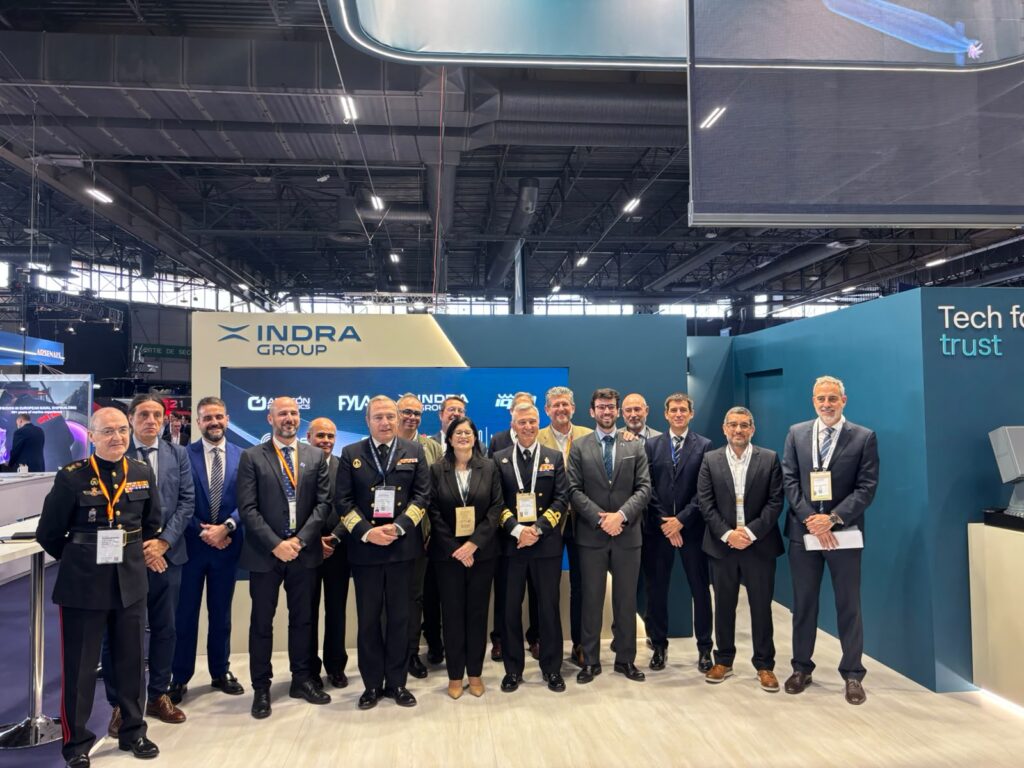
Paris, 4 November 2026.– Indra, SAES, UTEK, Aragon Photonics, Iqua Robotics, FYLA and Sateliot today signed a memorandum of understanding (MoU) to develop sovereign capabilities for persistent surveillance and the protection of underwater infrastructure through the SIPRIS project. The signing took place at Euronaval, the leading international naval defence event, held in Paris from 3 to 6 November.

Ana Belén Buendía, Director of Indra’s Naval Business Unit; César Solano, General Manager of SAES; César Martínez Fernández, CEO of UTEK; Francisco López Torres, CEO of Aragon Photonics; Marc Carreras Pérez, CEO of Iqua Robotics; Pere Pérez Millán, CEO of FYLA; and Jaume Sanpera Izoard, CEO of Sateliot, signed the memorandum of understanding.

Ana Belén Buendía, Director of Indra’s Naval Business Unit, stressed that “the SIPRIS initiative aims to provide Europe with technological sovereignty and specialised capabilities to address the urgent need to observe, understand and monitor the underwater domain”. She added that “collaboration between Spanish companies with cutting-edge, complementary capabilities will enable us to build an integrated solution, strengthen our technological autonomy and position Spanish industry in a field with enormous potential for development”.

Indra will act as the overall solution integrator and ecosystem coordinator, as well as defining the system architecture. The solution will draw on SEADEF, the company’s family of naval mission system products, and IndraMind, its sovereign AI-based intelligence and data exploitation platform. Indra will also contribute unmanned aerial vehicle (UAV) and communications management capabilities.

SAES brings its technological capabilities in underwater acoustics to the alliance, including the development of acoustic sensors and advanced sonar processing solutions for detecting and classifying underwater threats and activities.

UTEK will focus on autonomous surface vehicles (USVs), developing new vehicles tailored to this application that will extend the system’s coverage and surveillance area and provide inspection capabilities.

Iqua Robotics will develop autonomous underwater vehicles (UUVs) to carry out underwater infrastructure inspections and automatically detect anomalies.

Aragon Photonics contributes its expertise in high-fidelity distributed acoustic sensing (HDAS) technology using optical fibre, which enables acoustic events to be detected along tens of kilometres of underwater communications networks.

FYLA will contribute its expertise in underwater optical communications technologies, designed to facilitate information exchange between the various elements deployed underwater.

Finally, Sateliot will provide satellite communications and information systems to extend coverage and support the system’s distributed operations.

The signing of the agreement marks a first step towards building an industrial and technological ecosystem around SIPRIS capable of addressing emerging underwater surveillance needs. Integrating complementary capabilities will enable progress towards a shared, modular solution designed to evolve and incorporate new technologies as new operational needs arise.

SIPRIS is conceived as an initiative open to the gradual inclusion of other companies, technology centres and Spanish industry stakeholders that can contribute capabilities and help expand persistent surveillance of the underwater domain.

This agreement aligns efforts and facilitates operational demonstrations and joint integration and validation activities ahead of market deployment. Spanish industry thus strengthens its competitive position and consolidates its standing as a leader in a field accessible only to countries with the most advanced technological capabilities.
SAES Signs agreement with Aragón Photonics for innovation in maritime detection using optical sensors

SAES formalised a collaborative agreement with Aragón Photonics today to develop advanced maritime contact detection systems employing Distributed Acoustic Sensing (DAS) optical sensor technology. The initiative was formalised at the International Defence and Security Exhibition (Feindef), held in Madrid from 12 to 14 May.

The partnership between SAES and Aragón Photonics marks a significant advancement in maritime surveillance and protection. By utilising cutting-edge optical transducers, the new systems promise to deploy larger, lighter, and more sensitive arrays than current ceramic sensors. It is noteworthy that the term ‘array’ refers to a systematic arrangement of sensors aligned to allow for wider and more accurate detection coverage.

This technology aims not only to enhance the detection of threats and contacts at sea but also to tackle adverse environmental conditions with high levels of background noise, thus optimising the protection of infrastructures and ensuring precise target tracking.

During the event, Javier Mármol Peñalver, President of SAES, underscored the importance of the agreement: “This alliance with Aragón Photonics represents a significant advancement for maritime security and strengthens our commitment to integrating cutting-edge technologies that ensure a safer and more controlled environment. It is an important agreement that could transform the landscape of distributed acoustic detection.”

Francisco López, CEO of Aragón Photonics, remarked that “Aragón Photonics was established in 2004 with the mission, among others, to address society’s needs through the practical application of scientific and technological knowledge generated through R&D. For this purpose, and considering the growing sense of insecurity emerging in our society, we at APL deemed it fitting to explore the dual use of our distributed optical fibre sensing technologies, particularly in the field of maritime defence and security. Undertaking this task alongside a company with the prestige and experience of SAES provides us confidence that the process will be swift and effective.”

The collaboration comes at a pivotal moment for innovation in maritime security, with the first outcomes of this joint effort expected to be reflected in the next generation of detection systems. This will benefit both the industry and society at large by increasing the effectiveness of maritime infrastructure protection.  

2nd Global Tsunami Symposium organized by UNESCO-IOC

A part of the Aragon Photonics team traveled to Banda Aceh, Indonesia, to participate in the 2nd Global Tsunami Symposium organized by UNESCO-IOC.
Under the theme “Two Decades After the 2004 Indian Ocean Tsunami: Reflection and the Way Forward,” the event brought together experts and decision-makers from around the world to discuss the latest advancements in science, engineering, and early warning systems, aiming to improve preparedness and disaster mitigation for tsunamis.

In this context, Aragon Photonics presented the SAFE project, an innovative initiative funded by the HORIZON Action Grant Budget-Based program. This project aims to develop a tsunami early warning system utilizing the existing infrastructure of submarine fiber optic cables.

Our colleague Aitor Garcia Serrano, PhD, delivered an oral presentation highlighting the progress of the SAFE project. Additionally, we were present throughout the symposium with a booth and in the poster area with Poster 65📍. During the event, we showcased how our technology, based on DAS (Distributed Acoustic Sensing), is revolutionizing Earth sciences by enabling more effective early detection of tsunamis.

This symposium was not only an opportunity to share the progress of the SAFE project but also to establish professional connections with experts worldwide who share the same goal: improving safety and preparedness against this natural phenomenon.

Photonic Seismology: Lighting the Way Forward

We are excited to share that from October 7 to 10, we will be participating in the “Photonic Seismology: Lighting the Way Forward” meeting, hosted by the Seismological Society of America in Vancouver, where we are proud to be one of the sponsors.

During those days, three of our colleagues will be presenting how our HDAS technology, based on Chirped Pulse, offers excellent performance for analyzing events in the field of seismology and earth sciences.

If you would like to learn more about this topic, you can find us on Wednesday, October 9, from 5:00 PM to 7:00 PM at our exhibition space, where a demonstration with real data of our updated interface will be available.

In addition, you can check out a poster by our colleague Javier Preciado, which delves into how the application of array seismology methods in Distributed Acoustic Sensing data gathered in trackside fibers can provide a significant amount of information on the terrain features and the railway superstructure.

We hope to see you there!

Optica Sensing Congress 2024

Next week we will be at the Optica Sensing Congress, from July 15th to 19th at Le Centre de Congrès Pierre Baudis, Toulouse, France. During the congress, two of our colleagues will be giving talks on the Distributed Acoustic Sensing sector.

We would be delighted if you could join us:

The first talk, on Tuesday the 16th at 14:00, will be given by our colleague Javier Preciado, who will discuss the application of array seismology methods to Distributed Acoustic Sensor data collected in fibers along railway tracks. This collected data provides significant information about the terrain characteristics and railway superstructure.

Additionally, our colleague Jorge Canudo will be speaking on Friday the 19th at 16:45 about HDAS applications. He will focus on traffic monitoring, using CP-ΦOTDR technology in a fiber buried under the road shoulder.

We look forward to seeing you there!

Loading content
Loading content

Loading content
Loading content
